






Article: Is Your Care Label Itching? A Small Detail, With Thought Behind It

Is Your Care Label Itching? A Small Detail, With Thought Behind It
Sometimes, the details that matter most are the ones you barely notice.
When designing a garment, there are obvious decisions: the silhouette, the color, the fabric and the fit. But there are also many smaller decisions that you might never notice when looking at the finished piece. For us, these details deserve just as much consideration.
One of them is the humble care label.
Care labels are mandatory and provide important information about the composition of a piece of clothing, and how to look after it. But once you are wearing the garment, that little label can sometimes become much more noticeable than you would like.
That is why we attach ours a little differently.
Care Labels for Sensitive Skin
Why do clothing labels irritate the skin?
For some people, a care label is hardly noticeable. For others, particularly those with sensitive skin, it can become an irritating distraction throughout the day. A stiff edge or corner rubbing repeatedly against the skin can cause itching and discomfort, even when the garment itself feels beautifully soft.
With HSCPH, that’s one less thing you need to think about.
Comfort has always been an important part of the way we think about clothing. We want our clothes to feel comfortable, not only when you first try them on, but also after hours of wearing them. This means thinking beyond the softness of the fabric or the shape of the garment and considering even the smallest details that come into contact with your skin.
Of course, the simplest solution to an itchy clothing label might seem to be cutting it out. But anyone who has tried this knows that it is not always quite so simple.
Cut too close and you risk catching the garment itself. Leave anything behind and the remaining edge of the label can sometimes feel even more irritating than before.
Our design team has found a solution to this problem — a way for you to easily remove the care label without damaging your garment.
Remove a Care Label Without Damaging Your Clothes
In many garments, care labels are sewn directly into the main seam. This is the cheapest way to produce a garment, and it will leave a hole when removing the label completely. Then you are left with a damaged piece of garment that you need to repair.
At HSCPH, we do it differently.
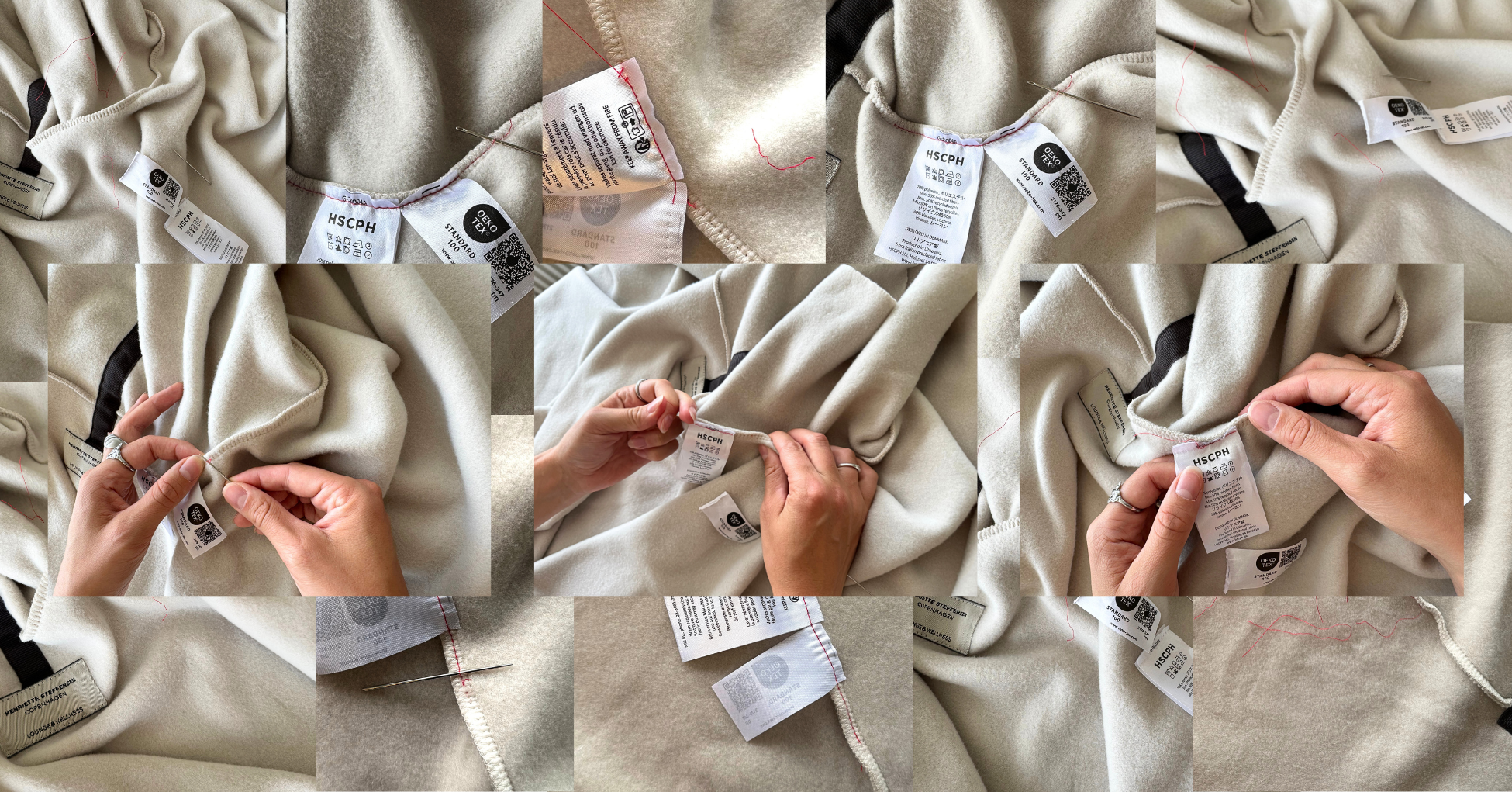
We attach the label separately with its own line of stitching. It is a small construction detail, but a deliberate one.
This additional seam means the label can be removed without opening or compromising the main seam of the garment.
It also means an extra step during production. It requires additional handling, stitching and time to make something that, at first glance, most people may never even notice.
But to us, that is part of thoughtful and functional design.
Not every design decision needs to be visible from the outside. Sometimes, good design is simply about anticipating a small annoyance and finding a better way to solve it.
How to Remove Clothing Labels
If your care label is bothering your skin, our construction makes it easy to remove.
Rather than cutting the label as close to the garment as possible, look for the separate stitching that holds the care label in place. On our accessories, we’ve made it even easier to spot: the separate stitching is red, so you can immediately see which thread to remove.
Carefully release the stitching, making sure not to catch the fabric underneath, or the main owerlock seam.
Because the care label has been attached separately from the garment's main seam, removing it does not affect the construction of the garment itself.
Just remember to keep the care label, as you may need the care instructions later.
It is a very small thing.
An additional seam. A little extra time in production. A detail hidden on the inside of a garment.
We believe clothing should be designed around the person wearing it — right down to the things you don’t notice.
–
Do you want to read more about the HSCPH universe and get inspiration and facts about our collections, the different materials we use and our EU-based production processes? Find all journal posts here.